
How to license corporate IP and trademarks to game and software developers
The convergence of real-world corporate brands and digital environments is accelerating. Today, the gaming industry and software development sectors are hungrier than ever for authentic assets. Whether it is a racing simulator requiring the exact trademarked design of a sports car, a first-person shooter needing the rights to realistic tactical gear, or a VR software developer looking to integrate a patented motion-sickness mitigation algorithm developed by an aerospace corporation, the demand for corporate intellectual property in video games and software is at an all-time high.
For corporations, this represents a massive, untapped revenue stream. Licensing your intellectual property—be it a trademark, a proprietary 3D design, or a patented technology—to digital creators should be a frictionless way to generate digital royalties. Yet, the reality is a stark contrast. The bridge between corporate IP holders and digital developers is fundamentally broken, choked by the archaic machinery of traditional corporate law.
To understand why 90% of these potential deals never happen, we must examine the severe friction paralyzing both sides of the table.
The developer’s dilemma: minimum guarantees and the royalty nightmare
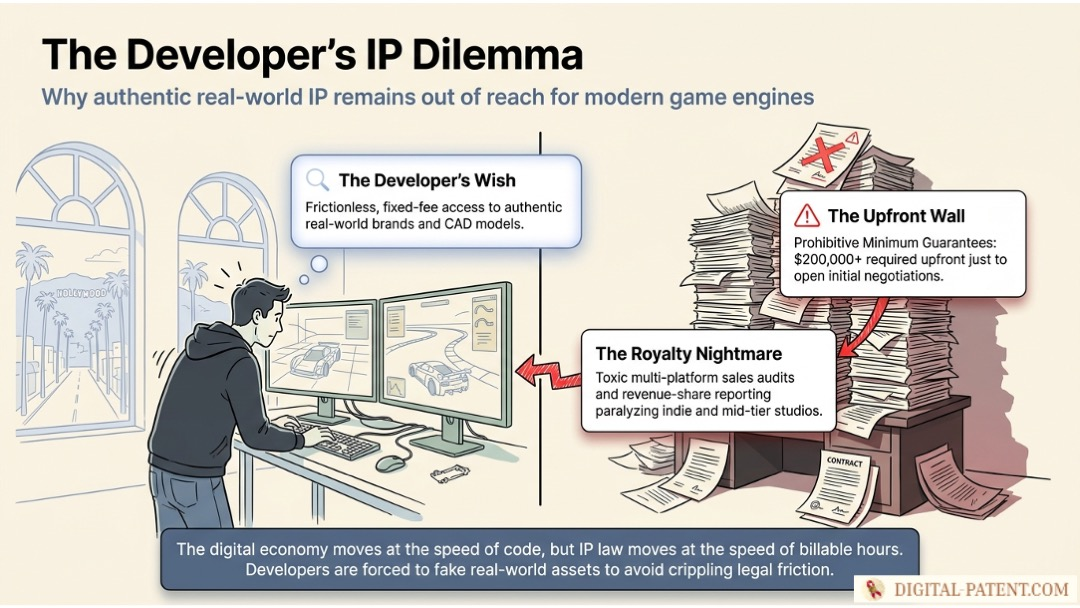
For game studios and software creators, attempting to legally license corporate IP often feels like an impossible quest. When an indie or mid-sized studio approaches a major corporation to license a trademark or a patented mechanic, they immediately hit two massive walls:
The giant upfront fee
Traditional corporate legal teams do not want to draft bespoke contracts for small amounts of money. Therefore, they demand a massive upfront minimum guarantee—often hundreds of thousands of dollars—just to open negotiations and grant the license. Indie and mid-tier developers simply do not have this cash reserves on hand before a game launch.
The royalty audit nightmare
If the corporation agrees to a revenue-share model (taking a percentage of game sales), it introduces a deeply toxic operational burden. The developer must constantly report sales figures across multiple fragmented platforms (such as Steam, PlayStation Network, Epic Games Store, and mobile app stores). In return, the corporation is forced to conduct invasive financial audits to ensure reporting accuracy.
For the developer, this IP licensing friction is so exhausting that it is often far easier to design a fictional substitute vehicle, invent a generic brand, or spend months writing a sub-optimal code workaround to avoid a patented algorithm. The developer loses authenticity and visual fidelity, while the corporation loses a direct, high-margin revenue stream.
The corporate bottleneck: legal overhead and the compliance trap
From the corporate perspective, the inability to scale IP licensing is a matter of administrative paralysis. Chief Innovation Officers and IP Managers know their trademarks and patents hold immense commercial value for the interactive software sector. But when it comes to licensing IP for game developers, they are trapped by their own compliance departments.
The retail licensing impossibility
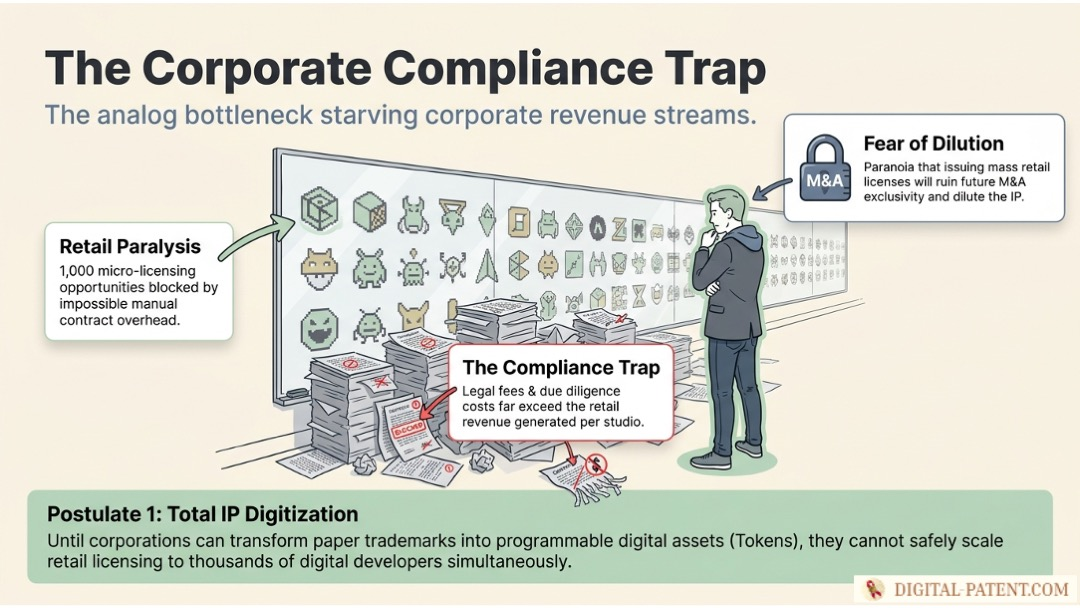
If a corporation wants to license a trademark to a single AAA studio for a multi-million-dollar deal, their legal team will happily spend six months negotiating and drafting the contract. But what if 1,000 mid-sized developers want to license that exact same trademark for a few thousand dollars each?
The corporation would earn the exact same revenue, but executing 1,000 bespoke paper contracts is physically impossible. The legal overhead, outside counsel fees, and compliance due diligence would far exceed the revenue generated.
Fear of dilution and loss of exclusivity
Corporations are terrified of losing strategic control. If they issue hundreds of non-exclusive licenses to various software developers, corporate executives fear it might jeopardize their ability to sell an exclusive master license or execute a clean corporate buyout with a major tech conglomerate later on. M&A lawyers and institutional investors despise messy IP portfolios with poorly tracked prior encumbrances.
The core problem: a digital economy running on analog paper
Ultimately, the failure of software developer IP licensing comes down to outdated infrastructure. The digital economy moves at the speed of code, but intellectual property law still moves at the speed of paper contracts and billable hours. Traditional licensing relies on manual negotiations, expensive legal intermediaries, and continuous auditing.
Until corporations can find a way to instantly sell fixed-price, non-exclusive digital licenses to thousands of developers simultaneously—without fear of auditing failures or destroying their future exclusive buyout options—the gaming and software industries will remain starved of real-world IP, and corporations will continue to leave billions of dollars on the table.
The Digital Patent AI solution: automating IP licensing through programmable law
To bridge the gap between corporate intellectual property and the expanding gaming and software markets, we must eliminate the friction: the paper contracts, the exhaustive audits, and the legal overhead. Digital Patent AI achieves this by upgrading traditional trademarks, designs, and patents into Programmable Law.
By transforming corporate IP into liquid digital tokens powered by automated smart contracts, our platform allows corporations to scale their licensing efforts infinitely while providing software developers with frictionless, instant access to the authentic assets they need.
Here is how our core technology resolves the licensing dilemma for both sides of the market.
1. Replacing royalty audits with immutable pricing
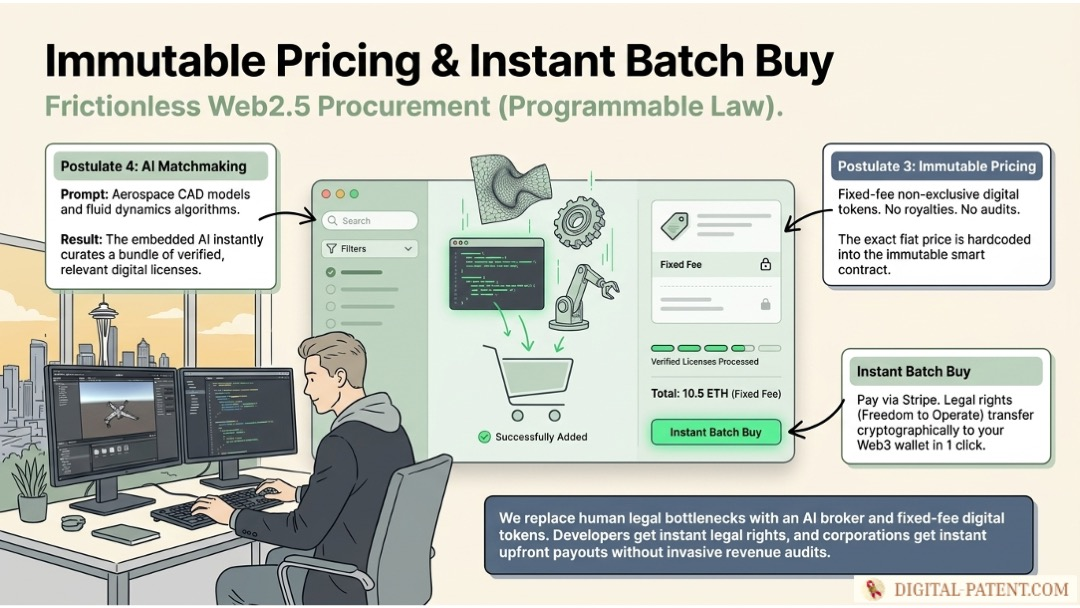
The platform eliminates the burdensome cycle of minimum guarantees and invasive revenue-share audits. Instead of demanding an unpredictable percentage of a video game’s future sales, corporations tokenize their IP on Digital Patent AI and establish a hard-coded, fixed price for a non-exclusive license. This mechanism is known as Immutable Pricing.
- For the developer: A game studio does not need to hire legal counsel to negotiate terms or surrender an ongoing percentage of game revenue. Developers simply select the non-exclusive token for the corporate trademark, CAD asset, or software algorithm, pay the fixed fee in fiat or crypto, and instantly receive verifiable legal rights. The transaction is transparent, instantaneous, and definitive.
- For the corporation: The primary sale of the token serves as an upfront, lump-sum licensing payout. The corporation receives funds immediately without ever needing to audit the developer’s accounting records or track multi-platform sales reports. The smart contract handles global distribution effortlessly. Selling a digital license to 10,000 indie developers becomes just as straightforward as executing a single major corporate agreement.
2. The Smart Lock guarantee: protecting strategic exclusivity
The primary barrier preventing corporations from licensing IP to game developers has been the fear that widespread retail licensing would devalue the asset for a future strategic M&A transaction.
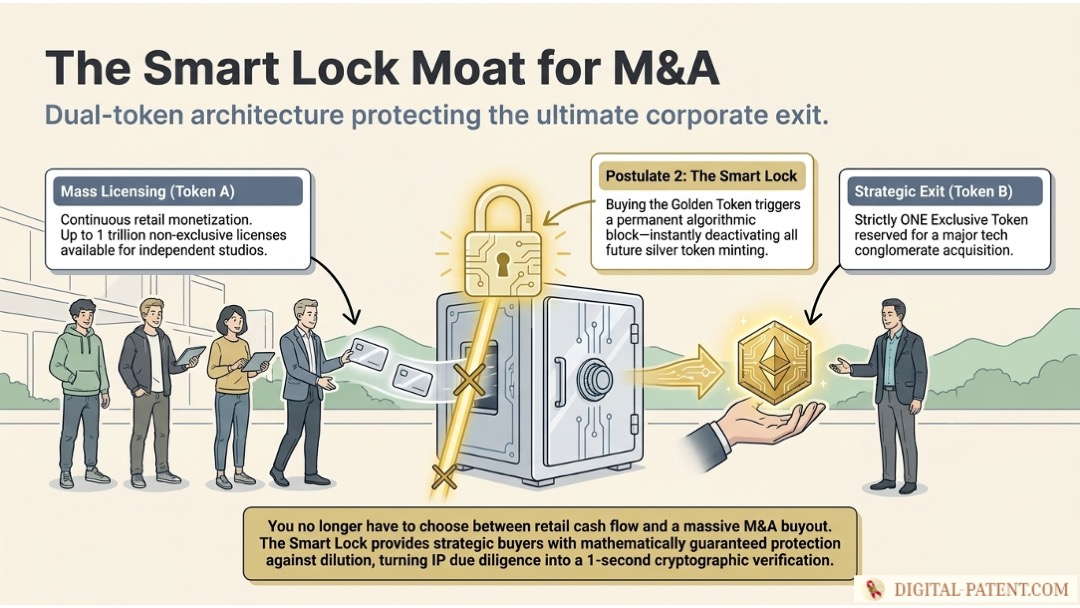
Digital Patent AI solves this through its proprietary Linked Token Pairs and Smart Lock architecture. When an enterprise tokenizes an asset on our platform, the smart contract generates two distinct, mathematically linked streams: a designated supply of Non-Exclusive Tokens (for software and game developers) and exactly ONE Exclusive Token (for a strategic acquirer).
- Continuous retail monetization: The corporation can safely monetize its trademark or patented mechanic in the retail gaming market today, generating continuous cash flow from thousands of independent studios.
- The irreversible Smart Lock: When a strategic acquirer, tech giant, or major publisher decides to acquire exclusive rights, they purchase the single Exclusive Token. The exact moment this transaction executes on the blockchain, the Smart Lock triggers automatically. It permanently and irreversibly blocks the smart contract from ever minting or selling any new non-exclusive tokens.
- Clean M&A due diligence: The strategic buyer is guaranteed complete protection against future dilution, while all pre-existing non-exclusive licenses remain valid and legally sound. This transforms M&A intellectual property due diligence from months of tedious document review into a single second of cryptographic verification.
3. AI-driven discoverability and instant batch procurement
Even when legal friction is eliminated, developers must be able to discover the precise corporate IP that fits their game engine or application stack. Traditional patent databases and trademark registers are notoriously difficult for software engineers to navigate.
Digital Patent AI solves this through its proprietary AI matchmaking engine. A technical director or lead game designer can simply describe their requirements in natural language:
“We are developing a hyper-realistic flight simulator and require authentic aerospace trademarks, alongside patented computational fluid dynamics algorithms.”
The AI assistant scans the decentralized registry, analyzes patent claims and technical specifications, and curates an optimized portfolio of relevant IP assets. With our One-Click Batch Buy capability, the studio can license multiple trademarks and patented mechanics simultaneously in a single transaction, achieving complete legal compliance in minutes rather than quarters.
The new standard for digital IP monetization
The era of slow, paper-based licensing is coming to an end. By leveraging Digital Patent AI, enterprise rights holders can unlock the massive latent value in their IP portfolios, safely licensing authentic trademarks and patented technologies to global game developers and software creators. Concurrently, developers are freed from the burdens of royalty audits and prohibitive minimum guarantees, allowing them to focus on creating outstanding digital experiences.
Explore how your enterprise can tokenize corporate IP or discover authentic assets for your next title on Digital Patent AI.
Learn more about the Digital Patent AI tokenization platform.