
The DeepTech catch-22: why licensing core AI kills your M&A exit
If you are a startup founder building standard software-as-a-service—such as a CRM, a collaboration hub, or a cloud accounting tool—monetization follows a predictable playbook. You configure an automated subscription billing flow, list your software on traditional reseller marketplaces, and charge a monthly recurring fee per user seat. The distributor retains their cut, the customer accesses a hosted web application, and the operational lifecycle remains clean.
However, deep-tech and artificial intelligence ventures operate in an entirely different universe. What happens when your startup does not build a superficial SaaS application, but instead develops Core IP?
Consider a technical team that has engineered a proprietary deep neural network and the underlying algorithmic codebase capable of detecting structural micro-defects on automotive assembly lines in real time. You are not selling user seats or metered API calls; you are offering foundational intellectual property. An international automotive manufacturing conglomerate needs to integrate your proprietary models directly into its private, on-premise industrial server clusters.
This is the exact threshold where the conventional software sales model disintegrates. Licensing Core IP, proprietary source code, or custom machine learning models unleashes an intricate sequence of legal, administrative, and structural complications that legacy distributors cannot resolve. Ultimately, this friction jeopardizes the founder’s paramount milestone: the strategic corporate buyout or M&A exit.
Why traditional distributors fail deep-tech innovators
When deep-tech founders attempt to license specialized source code, neural network weights, or patented mechanics through standard enterprise software channels, they immediately encounter a fundamental structural mismatch.
Conventional enterprise software distributors and marketplaces are engineered around standard End-User License Agreements (EULAs). Their operational architecture exists to sell commercial access to standardized, hosted software products.
These channels possess no legal or technical mechanisms to handle the transfer of proprietary source code, the partition of underlying patent rights, or the complex representations and warranties demanded when deploying mission-critical AI directly into industrial environments. An enterprise reseller cannot provide an automaker with the cryptographic guarantees or tailored indemnities required to embed third-party algorithms into a high-throughput factory floor.
Consequently, deep-tech ventures are forced to bypass established distribution networks entirely, shoulder the massive burden of direct enterprise negotiation, and navigate bespoke paper contracts that stretch across quarters.
The founder’s dilemma: immediate survival versus long-term valuation
Deprived of automated distribution, the deep-tech leadership team is confronted with an unforgiving dilemma.
To maintain operational runway, retain world-class machine learning engineers, and demonstrate commercial viability to early backers, the venture requires immediate cash flow. The commercial team approaches several global manufacturers to license its automated quality inspection model. Because each deployment demands a tailored, non-exclusive enterprise license, the startup consumes valuable months and substantial capital on outside counsel simply to formalize a handful of industrial implementations.
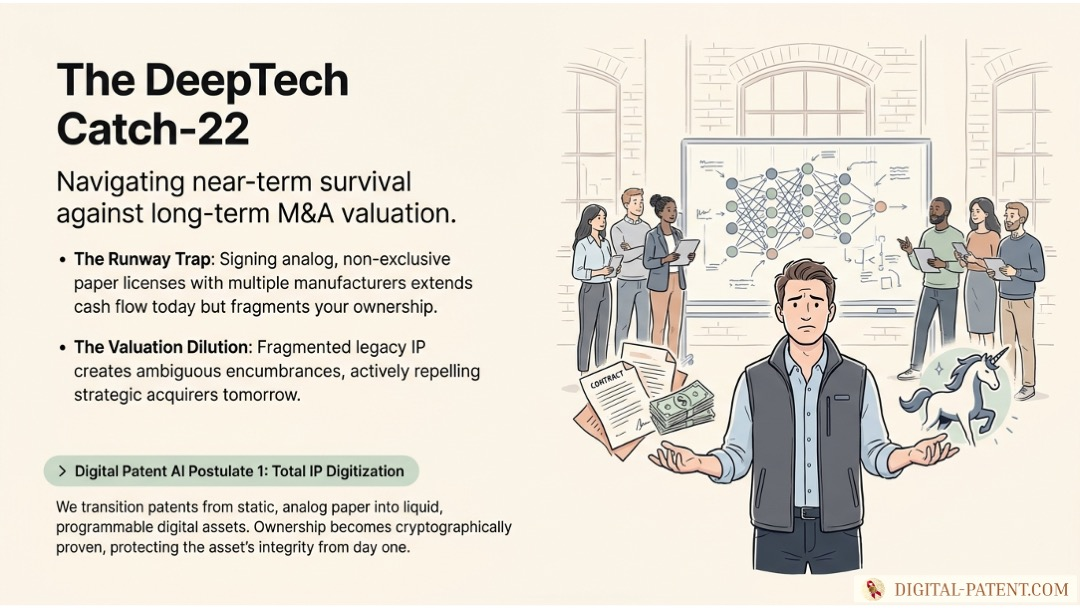
Yet, this path conceals a dangerous trap. For ambitious founders and venture investors, the objective is rarely to remain a minor niche vendor negotiating piecemeal contracts indefinitely. The ultimate goal is an expansive M&A acquisition: having an industrial titan acquire the startup, its research team, and its patent portfolio outright.
By distributing fragmented, non-exclusive paper licenses to multiple competing manufacturers to secure near-term survival, the startup inadvertently encumbers its intellectual property portfolio. These early commercial victories generate complex prior encumbrances that often become the exact structural flaw that derails a multi-million-dollar acquisition down the road.
The acquiring corporation’s perspective: due diligence paralysis
To comprehend why early enterprise licensing compromises future acquisitions, one must examine the transaction through the lens of the acquiring corporation’s legal and corporate development teams.
Suppose an automotive titan observes that your computer vision system identifies manufacturing defects with 99.9% precision. The enterprise leadership does not merely seek another vendor contract; they intend to acquire your company entirely to secure a durable technological monopoly, ensuring key competitors cannot deploy the same operational advantages.
The parties initiate the formal acquisition process. At this junction, analog corporate law introduces a severe bottleneck: intellectual property due diligence.
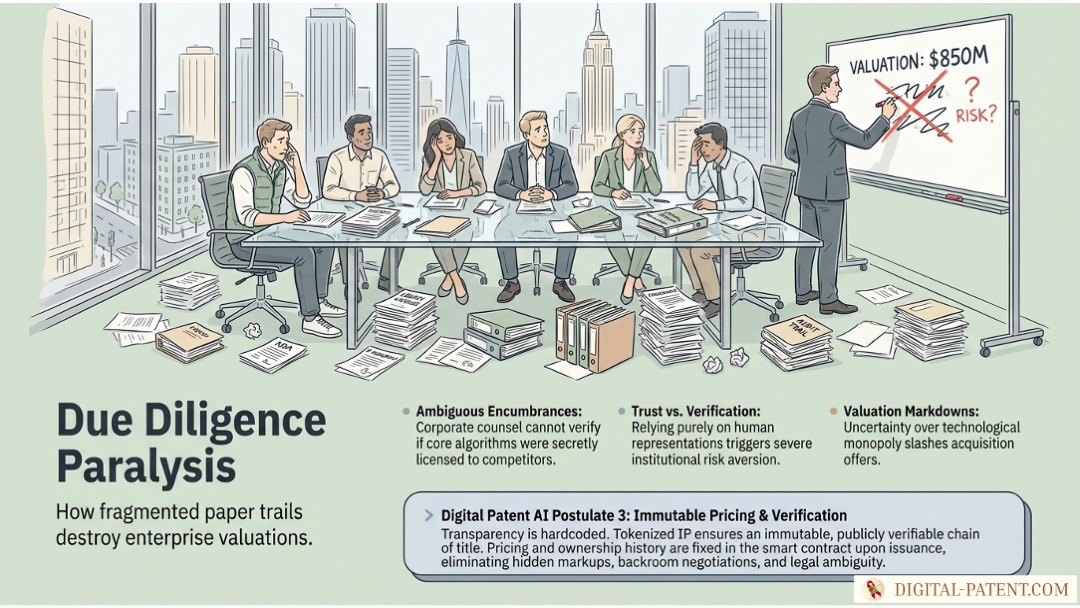
The acquirer’s legal team must meticulously audit every non-disclosure agreement, commercial memorandum, email exchange, and paper contract the startup has ever executed. This exhaustive scrutiny stems from institutional risk aversion.
How can corporate counsel be absolutely certain that the startup founders did not casually grant an unrecorded, perpetual non-exclusive license to an industry competitor during an informal early-stage partnership? Because traditional licensing relies entirely on human representations, corporate attorneys operate under structural caution.
If due diligence uncovers that the underlying algorithms were previously licensed to three other competing automotive brands to maintain early runway, the acquiring titan will frequently reduce its valuation or terminate discussions entirely. Their investment thesis was founded on monopolistic exclusivity, and an ambiguous paper trail irreparably undermines their confidence.
The structural deadlock of analog intellectual property
The prevailing legal environment enforces an unproductive trade-off. Emerging innovators are penalized for generating early revenue, traditional distributors are structurally incapable of facilitating deep-tech asset sales, and strategic acquirers are paralyzed by the legal friction of verifying ownership history.
While the digital economy advances at the speed of artificial intelligence, the legal mechanisms governing the commercialization and transfer of that technology remain constrained by analog paperwork.
Until innovators can sell standardized, non-exclusive digital licenses at fixed rates to multiple enterprise clients simultaneously—without incurring audit disputes or impairing their future exclusive acquisition value—the industrial sector will struggle to access cutting-edge AI, and deep-tech enterprises will continue to compromise their enterprise valuation.
The Digital Patent AI framework: elevating core IP to programmable law
To resolve the deep-tech paradox, technological leaders must modernize how intellectual property is formatted, licensed, and transferred. Startups cannot rely on consumer SaaS marketplaces to license core algorithms, nor can they depend on vulnerable paper contracts if they intend to preserve their long-term acquisition prospects.
The answer lies in converting proprietary algorithms and patents into Programmable Law through the Digital Patent AI platform. By integrating blockchain-verified tokenization, Immutable Pricing, and proprietary Smart Lock architecture, the platform reconciles near-term commercialization with long-term strategic exclusivity.
Here is how the infrastructure transforms the commercial lifecycle of mission-critical AI assets:
1. Volume-based tokenization without reseller overhead
Deep-tech enterprises require immediate enterprise revenue without relinquishing 30% margins to software resellers or spending tens of thousands of dollars on custom legal drafting for every single plant deployment.
Through Digital Patent AI, the innovator defines the operational scope of their intellectual property by issuing a dedicated supply of Non-Exclusive Tokens linked directly to measurable industrial metrics.
- Defining utility: The enterprise defines the concrete utility of the token. For instance: 1 Token represents the verified legal license to execute the neural network model on 1 active manufacturing line.
- Immutable pricing: The licensor establishes a hard-coded, transparent price per token within the smart contract.
- Frictionless enterprise procurement: When an industrial engineering team seeks to deploy the technology across ten manufacturing facilities, they avoid prolonged contract negotiations. They execute a One-Click Batch Buy directly through our platform, acquiring ten non-exclusive tokens in fiat or digital assets.
- Operational efficiency: By bypassing intermediaries, the licensor retains full commercial value, minus a flat 2.5% platform transaction fee. The startup achieves immediate, auditable commercial validation while conserving critical operational runway.
2. The Smart Lock: safeguarding strategic M&A acquisitions
While generating operational cash flow is vital, protecting the enterprise’s eventual acquisition value remains paramount. Digital Patent AI provides an automated mechanism specifically designed to preserve strategic transaction viability.
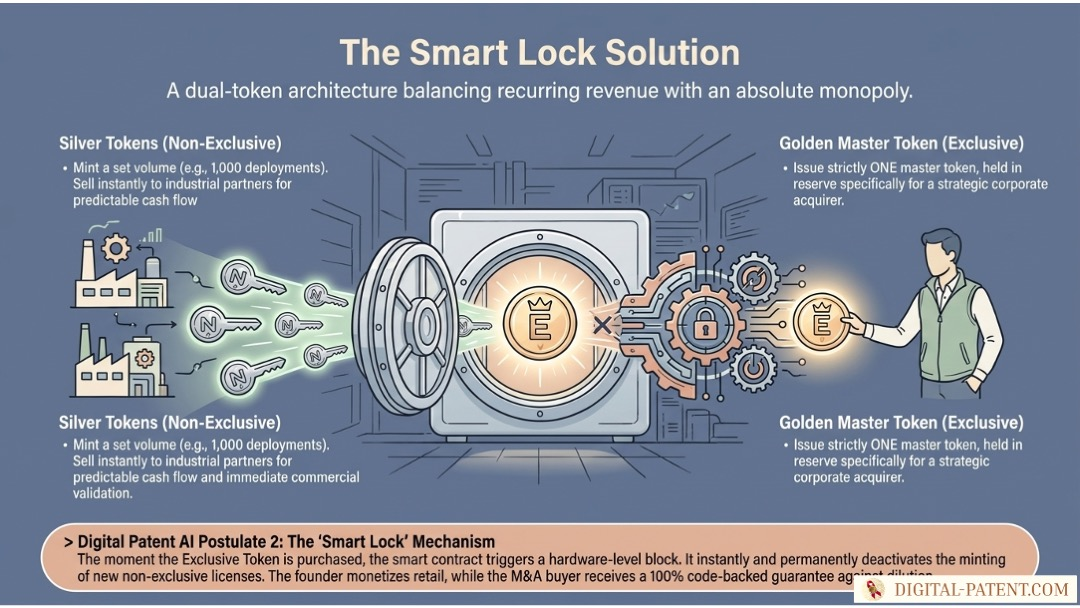
When an asset is initially tokenized on the platform, the smart contract generates two distinct, coordinated channels of legal rights: a finite allocation of Non-Exclusive Tokens (for ongoing industrial deployment) and exactly ONE Exclusive Token (representing complete asset ownership).
- Sustained commercial licensing: The startup licenses its technology to enterprise clients today, demonstrating authentic market demand and generating predictable recurring cash flow.
- The automated exclusivity switch: When a major industrial conglomerate elects to acquire full ownership of the intellectual property, it purchases the single Exclusive Token. The exact millisecond that transaction is confirmed on the decentralized ledger, the platform’s Smart Lock triggers automatically. It permanently and irreversibly deactivates the smart contract’s ability to mint, issue, or transfer any subsequent non-exclusive tokens.
- Cryptographic monopoly guarantees: The strategic buyer receives an uncompromised, mathematically enforced monopoly. They do not rely solely on contractual representations; they rely on immutable code execution. Concurrently, all previously purchased non-exclusive licenses remain legally sound and clearly documented, ensuring the transaction closes smoothly without valuation penalties.
3. Transparent provenance and instantaneous chain of title
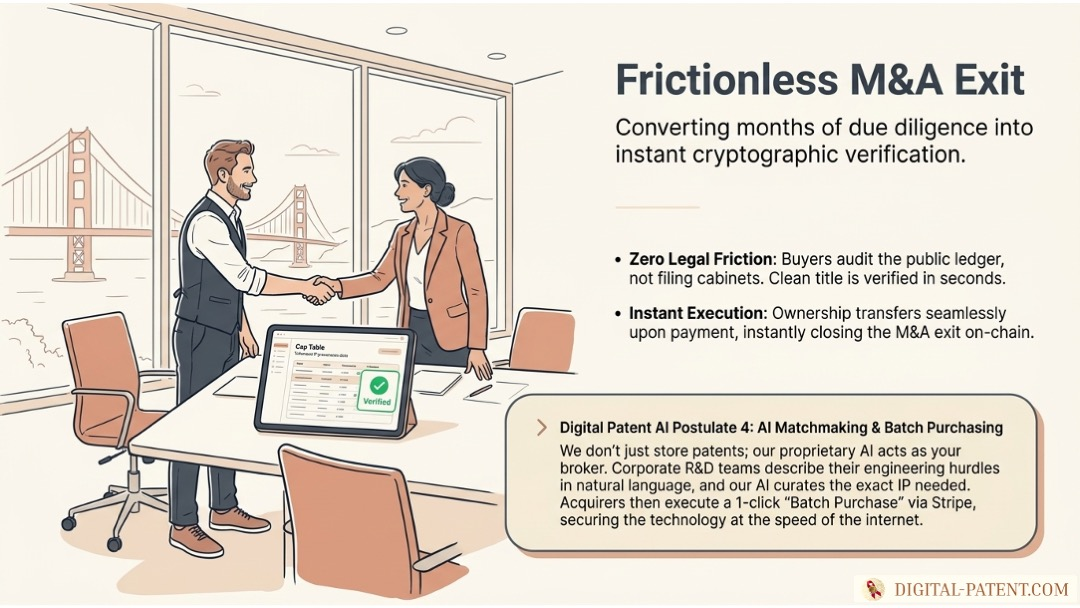
For corporate counsel and M&A advisory teams, Digital Patent AI converts months of tedious due diligence into instantaneous cryptographic verification.
Prior to acquiring the Exclusive Token, the buyer’s legal team inspects the public ledger, which provides an immutable, complete record of every non-exclusive license ever generated, its parameters, and its verified recipient. Informal, unrecorded commitments become structurally impossible.
Furthermore, this operational clarity extends beyond the initial buyout. Once the acquiring conglomerate secures the Exclusive Token, it assumes full ownership of the cryptographic Chain of Title. Should the new owner choose to monetize secondary applications of the asset, it can utilize the platform to program a new series of non-exclusive licenses at revised price tiers, managing the complete asset lifecycle within a unified, transparent digital environment.
The modern infrastructure for deep-tech commercialization
The era of paper-bound intellectual property management is giving way to automated digital infrastructure. By building on Digital Patent AI, deep-tech ventures can monetize their research immediately, safely distributing proprietary technologies to global enterprise clients without compromising their corporate destiny.
Simultaneously, enterprise acquirers gain absolute confidence that their strategic investments remain fully protected by immutable code.
Learn how your enterprise can tokenize proprietary algorithms or acquire verified industrial IP on Digital Patent AI.
Learn more about the Digital Patent AI tokenization platform.