
Digital Patent AI: why your intellectual property needs to become programmable
The analog bottleneck: why your intellectual property needs to become programmable
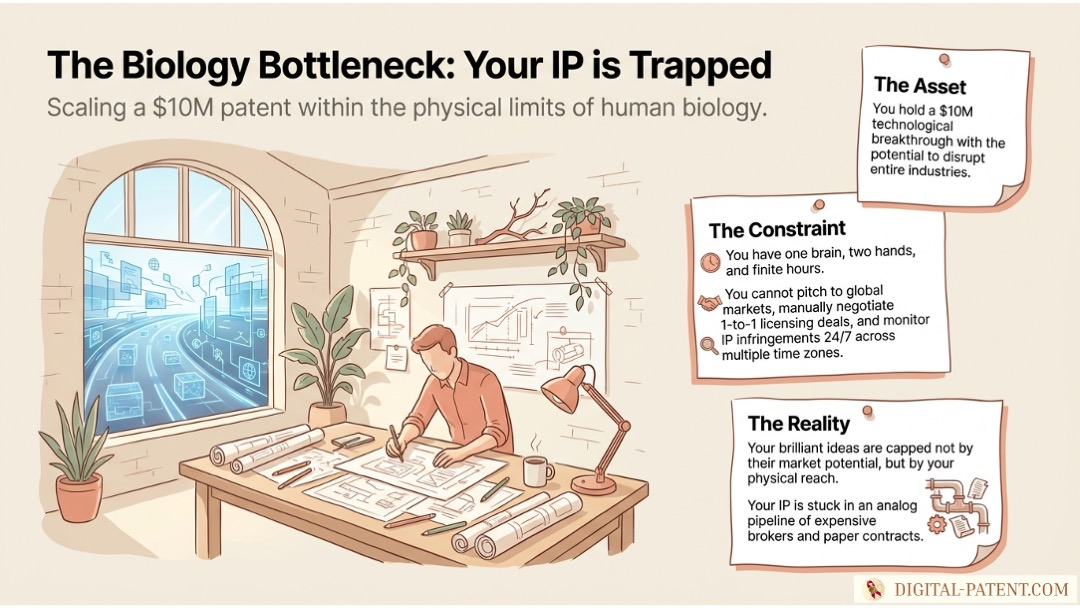
Imagine holding a tangible asset valued at $10 million. If it were a corporation, it would have a dedicated sales force, a legal department, and an automated infrastructure working around the clock to generate yield. But in the realm of intellectual property, a $10 million patent is usually managed by a single individual—or a severely understaffed university tech transfer office—operating at the absolute limits of human bandwidth.
Every IP owner shares the same inescapable biological constraints. You have two hands, two eyes, and one brain. You need to sleep, eat, and disconnect. You simply cannot simultaneously scour millions of global market opportunities, negotiate with thousands of prospective buyers, monitor every licensing conflict, and manually execute cross-border transactions.
Yet, the global IP infrastructure stubbornly ignores this reality. It was built for a paper-based era, not for modern, frictionless digital markets. Today, the lifecycle of a brilliant idea is trapped in a grueling, analog pipeline: static documents are handed to expensive lawyers, buried in siloed government databases, and subjected to months of manual, one-to-one licensing negotiations.
This creates a brutal paradox in the modern innovation economy. Your intellectual property might possess the technological potential to disrupt entire industries, but you do not possess the operational capacity of a multinational corporation to scale it.
Ultimately, the true value of your IP is no longer limited by its inventive brilliance. It is limited strictly by your physical ability to reach the market.
The architecture of programmable IP
What if you could transform any piece of intellectual property into a liquid, licensable digital asset in a matter of minutes—and algorithmically prevent conflicting licenses from ever being issued?
This is the inflection point where Digital Patent AI enters the equation. We are not building yet another static patent database; we are building the infrastructure for programmable intellectual property. By converging Artificial Intelligence with blockchain technology, we are shifting IP from a rigid legal construct into a dynamic, machine-executable asset.
This transformation is built upon a frictionless, three-tier architecture: Discover, Tokenize, and License.
Discover: from keyword search to problem solving
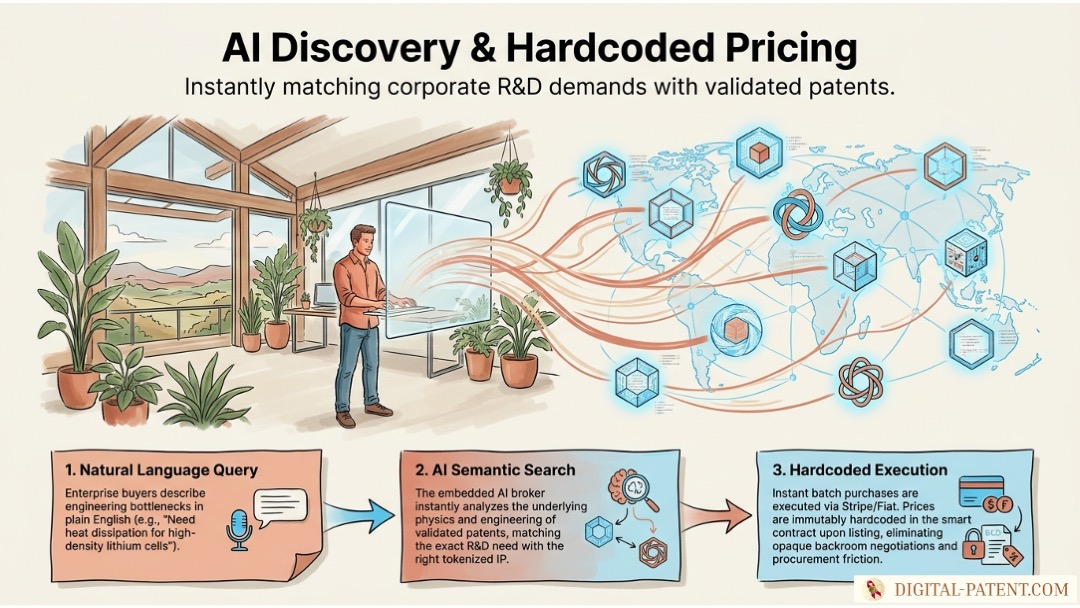
Historically, finding the right IP required armies of analysts parsing through archaic, jargon-heavy databases. AI changes the paradigm. On our platform, a corporate R&D director doesn’t search for a 10-digit patent number. Instead, they input a direct business problem into our chat interface: “We need a technology to reduce energy consumption in industrial refrigeration.”
The AI doesn’t just read documents; it acts as a highly specialized broker, instantly scanning the platform’s validated database to curate the exact patents that solve that specific engineering bottleneck. Clients can then execute an instant, one-click “batch purchase” of all recommended licenses, compressing months of R&D procurement into a few keystrokes.
Tokenize: structuring the asset and immutable pricing
Once the IP is onboarded, it is tokenized—converted into a cryptographically secured digital asset. But tokenization here is not a buzzword; it is a mechanism for absolute market transparency. At the exact moment of issuance, the price of the intellectual property is hardcoded into the smart contract. There are no opaque backroom negotiations, no hidden markups, and no moving goalposts. Enterprise buyers and investors get an ironclad guarantee of the asset’s price, drastically reducing the friction of due diligence.
License: algorithmic exclusivity (the Smart Lock)
This is the core differentiator where blockchain transcends mere record-keeping and becomes an active regulator. One IP. Two licensing models. One algorithm.
In the physical world, managing rights is fraught with risk. Non-exclusive licenses can comfortably coexist, but an exclusive license demands absolute isolation. Traditionally, ensuring an inventor hasn’t secretly sold parallel rights requires extensive legal auditing. Digital Patent AI turns this into a machine-executable rule through our dual-token architecture.
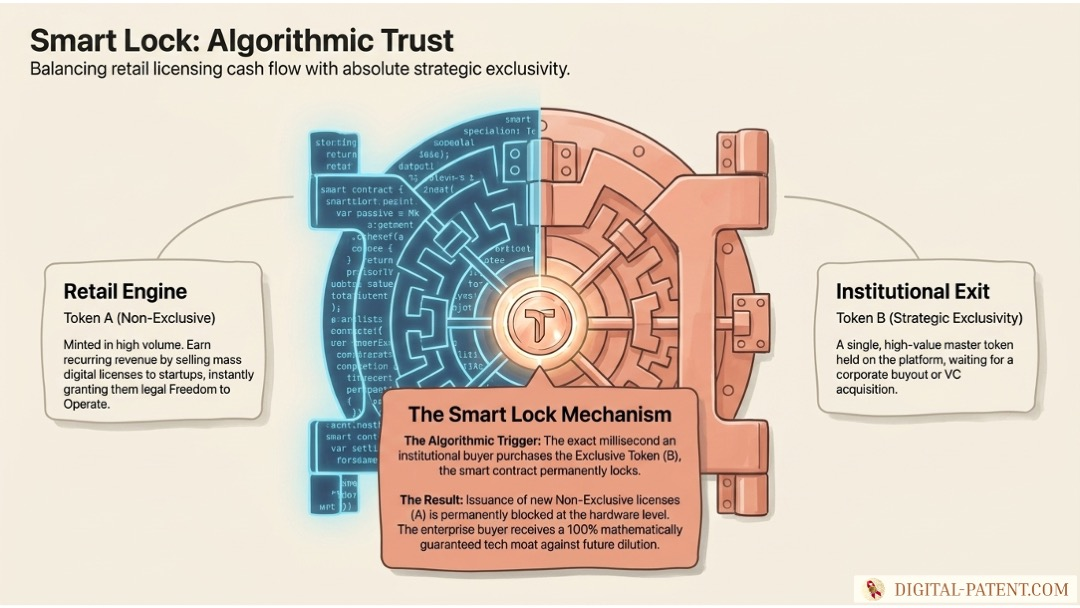
We issue rights as a connected pair: a predefined volume of mass Non-Exclusive tokens, and strictly one Exclusive token.
An inventor can seamlessly retail Non-Exclusive License #1, #2, and #3 to various startups, generating immediate cash flow. However, the millisecond a strategic corporate investor purchases that single Exclusive token, the blockchain logic shifts the state: EXCLUSIVE = TRUE. The smart contract instantly, automatically, and permanently blocks the issuance of any new non-exclusive licenses.
The blockchain doesn’t just represent the rights—it algorithmically enforces them. The creator monetizes their asset at the retail level, while the institutional buyer receives a 100% mathematically backed guarantee that their multi-million-dollar exclusive asset is entirely safe from dilution.
For a detailed analysis of the mathematical model and dual-token state machine, see the Aething encyclopedic monograph.
From individual capacity to global market scale
At its core, Digital Patent AI does not conjure value out of thin air. It cannot make a fundamentally flawed patent valuable. What it does, however, is dismantle the friction that keeps immense value trapped in isolation. We don’t make your intellectual property more valuable—we make its potential infinitely more accessible.
By removing the analog barriers between a creator and the corporate capital eager to license their work, the platform fundamentally redefines the economics of innovation. It is an infrastructure designed specifically to close the widening gap between human physical limitations and global market demand.
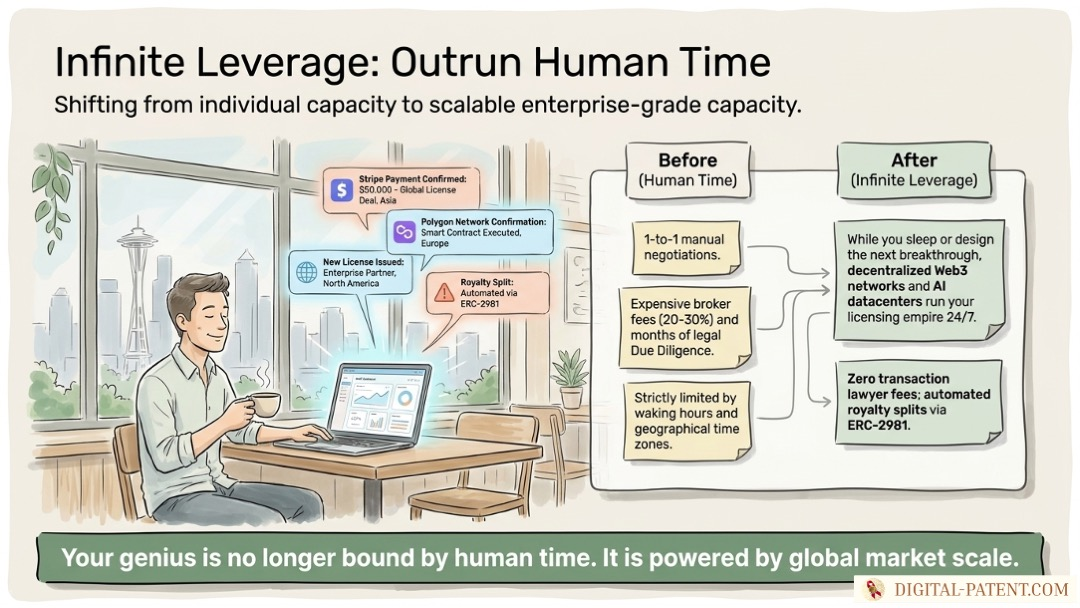
Consider the stark contrast between the traditional approach and the programmable IP model:
While a human brain is bound by cognitive load and finite hours, our embedded AI processes millions of complex engineering queries at machine scale, actively matchmaking your technology with the exact corporate buyers who need it.
Where two hands can only draft, negotiate, and sign a limited number of licensing agreements per year, blockchain-based smart contracts execute thousands of secure, cryptographic transactions simultaneously.
While you sleep, take a weekend off, or focus on your next breakthrough, the decentralized ledger does not. It operates 24/7, relentlessly exposing your digital assets to global enterprise R&D budgets and institutional venture funds across every time zone.
When you tokenize your intellectual property on Digital Patent AI, you are no longer constrained by geography, legal bottlenecks, or the agonizingly slow pace of traditional corporate procurement. You are effectively arming your IP with the operational leverage of modern AI data centers and the impenetrable security of Web3 networks.
You remain one person. But your market reach no longer has to be confined to a one-person scale. By connecting your intellectual property to AI discovery and programmable blockchain licensing, Digital Patent AI turns individual human capacity into scalable, enterprise-grade market capacity.
You are inevitably bound by the limits of human time. Your intellectual property should not be.
Learn more about the Digital Patent AI tokenization platform.