
Smart contracts vs. traditional IP licensing: what patent lawyers need to know in 2026
Picture the scene: you have just successfully secured a complex patent for a client. As you discuss the commercialisation strategy, the 20-something founder of the tech start-up asks, “Right, so can we tokenise this to sell licences on-chain?”
If your immediate instinct is to discreetly search for a tokenized patents for lawyers tutorial under the desk, you are certainly not alone.
For many seasoned patent attorneys, the sudden influx of Web3 terminology—blockchain, tokens, decentralised ledgers—sounds like an entirely different language. However, as we navigate 2026, understanding smart contracts for IP licensing is no longer optional; it is a critical commercial requirement for your clients.
Fortunately, the reality is far less intimidating than the jargon suggests. Smart contracts are not here to replace the law, nor are they a substitute for meticulous legal drafting. Rather, they act as a flawless digital notary and an automated escrow account. They operate as Ricardian contracts—where legally binding agreements are tethered directly to executing code.
To understand how this revolutionises the commercialisation of intellectual property, we need to look at how modern platforms like Digital Patent AI have rebuilt the IP lifecycle around four fundamental pillars.
-
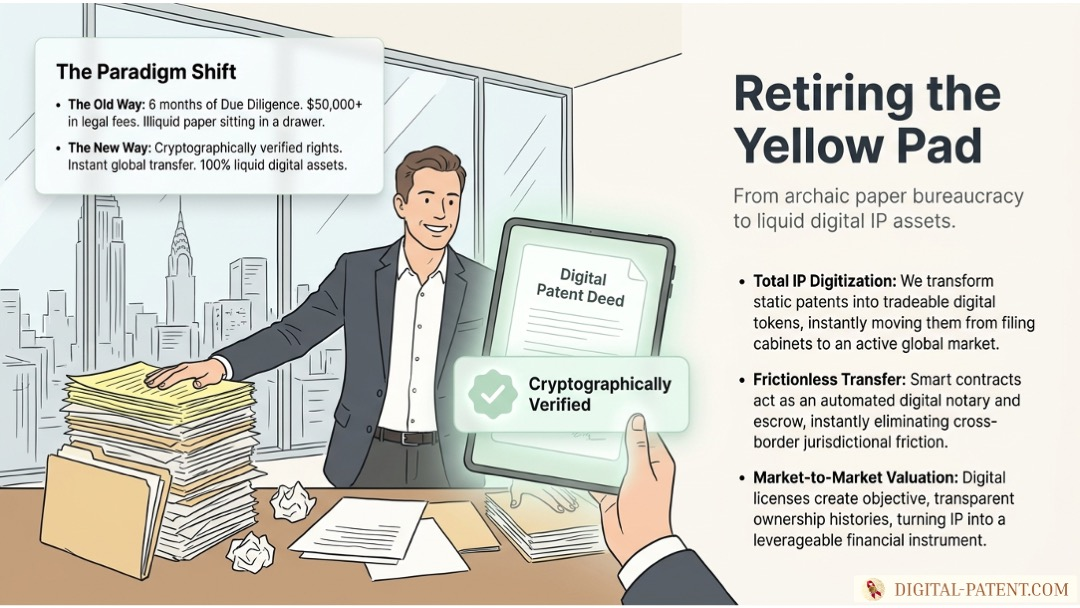
Total IP Digitisation Traditional paper-based licensing is notoriously cumbersome, involving weeks of due diligence, cross-border jurisdictional friction, and slow banking rails. We are transitioning patents from static paper formats into highly liquid digital assets (tokens). Through digitisation, the chain of title and ownership becomes cryptographically proven, globally accessible, and ready for instantaneous transfer.
-
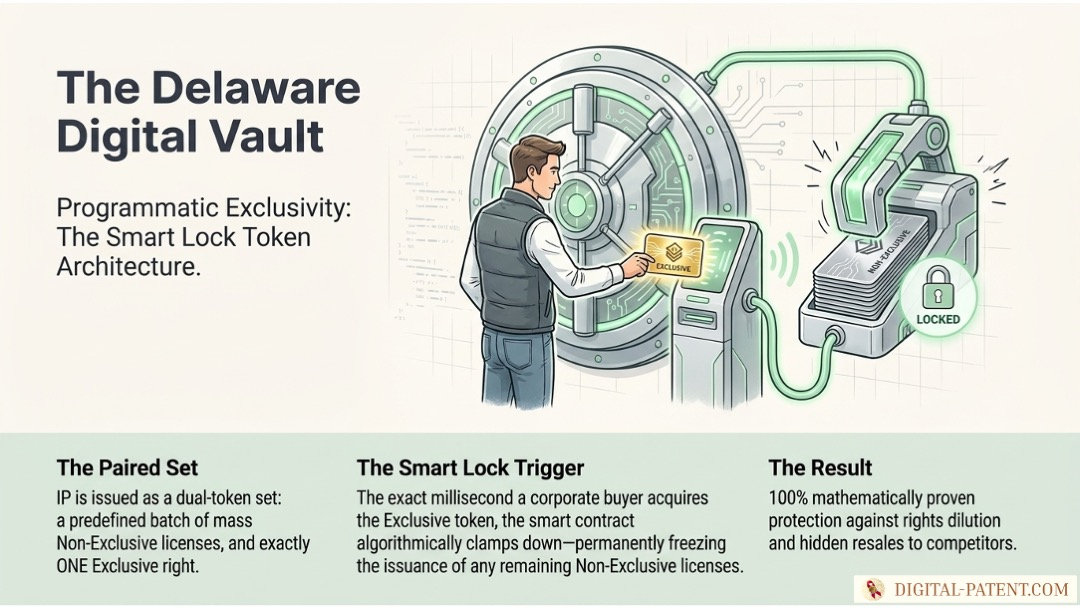
The “Smart Lock” Mechanism (Paired Tokens) In traditional licensing, a corporate investor acquiring exclusive rights must trust that the inventor hasn’t secretly issued a dozen non-exclusive licences to competitors. Digital Patent AI solves this through an innovative paired-token architecture.
Tokens are issued in a strict pair: a predefined volume of mass non-exclusive licences, and exactly one exclusive right. Our unique smart contract guarantees a “Smart Lock”: the very second the exclusive token is purchased by a strategic investor, the issuance of any new non-exclusive licences is blocked at the hardware level. It is the perfect commercial balance—the inventor monetises the asset at the retail level, whilst the institutional investor receives a 100% code-backed guarantee protecting their exclusivity from dilution.
-
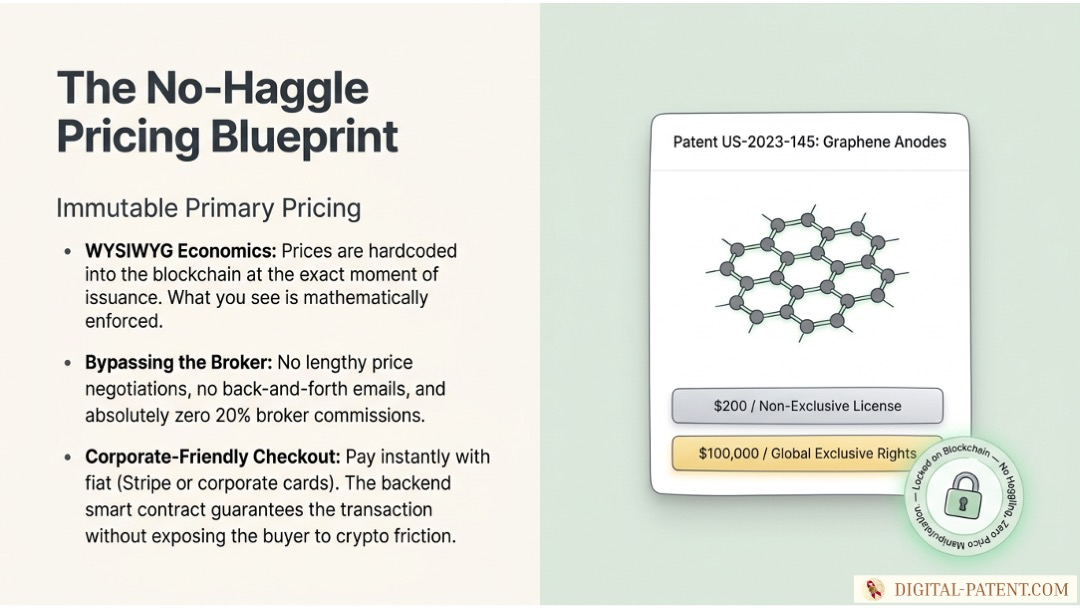
Immutable Pricing In traditional negotiations, pricing can be a prolonged and opaque process. On the Digital Patent AI platform, the price of the intellectual property is strictly hardcoded into the smart contract at the precise moment of issuance. Nobody—not the platform, nor the inventor—can alter it during the primary sale. This provides corporate businesses and investors with absolute transparency and a mathematically backed guarantee against hidden mark-ups or seller manipulation.
-
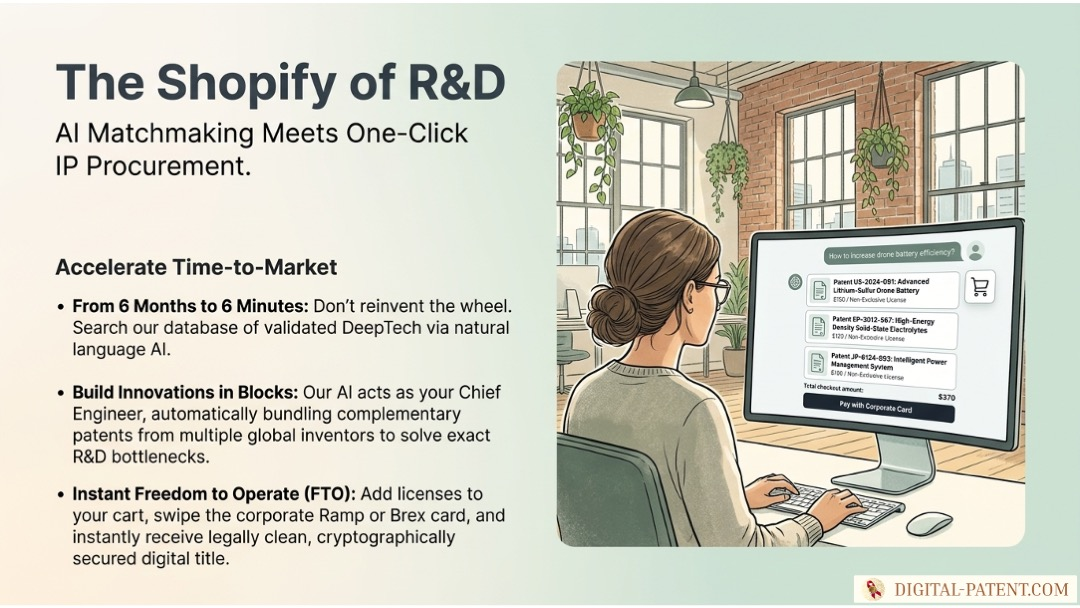
AI Matchmaking & Batch Purchasing A patent sitting in an archive generates no revenue. Digital Patent AI doesn’t merely store patents; it puts them to work. Our proprietary embedded AI deeply analyses the entire database of uploaded assets. When a corporate R&D team describes an engineering challenge in our chat interface, the AI acts as a broker, curating the ideal patents required to solve it.
The platform’s unique capability allows the client to execute an instant, one-click “batch purchase” of all recommended digital licences directly from the chat interface—compressing months of R&D and legal procurement into mere minutes.
The opportunity for forward-thinking law firms
As an IP professional, your core value remains the same: protecting your client’s inventions. But today’s innovators demand rapid, global commercialisation.
Rather than viewing blockchain as a threat, savvy attorneys are using this IP blockchain guide for attorneys to transition from traditional advisors to modern innovation partners.
Stay one step ahead. Do not lose your tech-centric clients to digital-first competitors. Offer patent tokenisation as an advanced, value-added service for your firm through our white-label platform. Guide your clients to Digital Patent AI, help them instantly monetise their assets on a global scale, and cement their loyalty for life.
[Partner with Digital Patent AI Today – Equip Your Firm for the Future of IP Licensing]
Ready to explore new avenues for IP monetization? Discover how the Digital Patent AI platform can empower your law firm to assist clients with patent tokenization, smart contract licensing, and securing exclusive buyouts in the modern digital marketplace.
Learn more about the Digital Patent AI tokenization platform.